The Basics
Tennis Scoring Explained for Beginners
Chloe · 26 June 2026 · 12 min read
Tennis scoring can feel confusing at first. Love means zero, 40 does not follow 30 in the normal way, and somehow a player can be winning a set 5–4 but still not have won the set yet.
The good news is that tennis scoring is much easier once you understand the order:
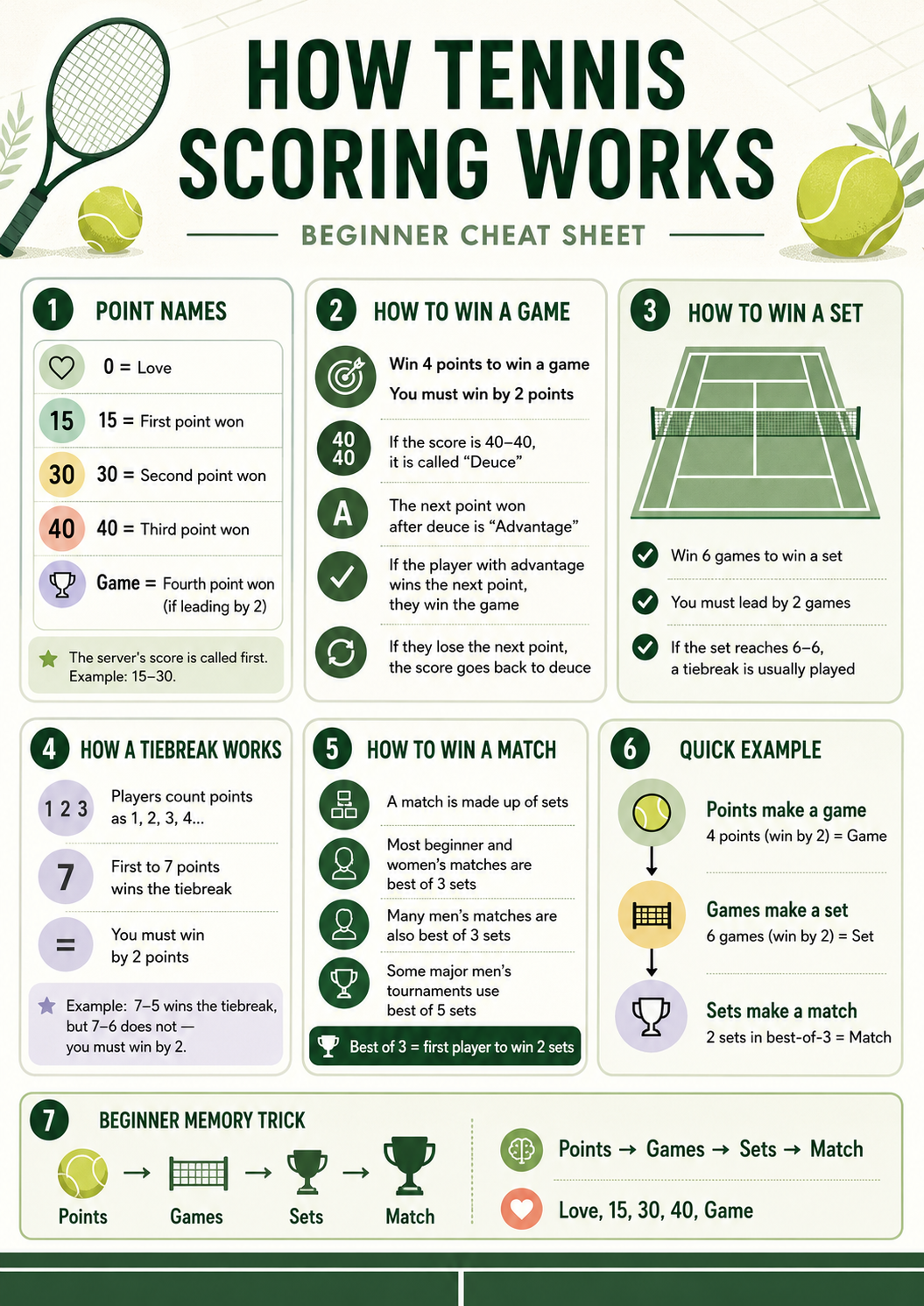
Points make up a game. Games make up a set. Sets make up a match.
This guide breaks down tennis scoring simply so you can follow a match, play your first lesson, or watch a tournament without feeling lost.
Table of Contents
- The Simple Tennis Scoring Structure
- How Points Work in Tennis
- What Does Love Mean in Tennis?
- What Is Deuce in Tennis?
- What Does Advantage Mean in Tennis?
- How Games Work in Tennis
- How Sets Work in Tennis
- What Is a Tiebreak in Tennis?
- How Matches Are Scored
- How to Call the Score Out Loud
- Try It: Simulate a Game
- Beginner Mistakes to Avoid
- Cheatsheet
The Simple Tennis Scoring Structure
Think of tennis scoring like building blocks.
Point. One rally. Someone wins the point when the opponent misses, hits out, hits into the net, double faults, or cannot return the ball legally.
Game. A group of points. The first player to win a game adds one game to the set score.
Set. A group of games. A player usually wins a set by reaching six games with a two-game lead.
Match. A group of sets. Most beginner, recreational, and women's professional matches are best of three sets. Men's Grand Slam singles matches are usually best of five sets.
So when you see a score like 6–4, 3–6, 6–2, that means the player won the first set 6–4, lost the second 3–6, and won the final set 6–2.
How Points Work in Tennis
Tennis does not count points as 1, 2, 3, 4. Instead, the points inside a game go:
Love → 15 → 30 → 40 → Game
Tap each step below to see what it means.
The server's score is always said first. So if the server wins the first point, the score is 15–Love. If the receiver then wins the next point, it becomes 15–all.
What Does Love Mean in Tennis?
In tennis, love means zero.
So if the score is 15–Love, the server has won one point and the receiver has won zero. If the score is Love–30, the server has zero points and the receiver has won two.
It sounds unusual at first, but once you hear it a few times it becomes part of the rhythm of the sport.
What Is Deuce in Tennis?
Deuce happens when both players reach 40. Instead of saying 40–40, tennis uses the word deuce.
At deuce, the game is not over. A player must win two points in a row to win the game. Tap through the flow below to see exactly how it works.
What Does Advantage Mean in Tennis?
After deuce, the next point gives one player advantage. If the server wins the point after deuce, the score is Advantage server (also called Ad-In). If the receiver wins, it is Advantage receiver (also called Ad-Out).
The player with advantage needs to win one more point to win the game. If they lose the next point, the score returns to deuce. Think of advantage as being one point away from winning, but only after deuce.
How Games Work in Tennis
A game is won when a player wins enough points and leads by two. For example:
- Server wins point 1 → 15–Love
- Server wins point 2 → 30–Love
- Receiver wins point 3 → 30–15
- Server wins point 4 → 40–15
- Server wins point 5 → Game
The server wins that game and the set score becomes 1–0. Then the other player serves the next game. In tennis, players take turns serving complete games.
How Sets Work in Tennis
A set is made up of games. Most sets are won by the first player to reach six games, but they must win by two games.
- 6–0, 6–1, 6–2, 6–3, 6–4 all win the set
- 7–5 wins the set (the trailing player forced it to 5–5, but lost the next two)
- 7–6 wins the set if a tiebreak is played at 6–6
- 6–5 does not win the set — the player is only ahead by one game
What Is a Tiebreak in Tennis?
A tiebreak is used when a set reaches 6–6. Instead of continuing regular games indefinitely, players play a special game using normal numbers: 0, 1, 2, 3…
A standard tiebreak is won by the first player to reach 7 points, with a two-point lead. So 7–0, 7–3, and 7–5 all win the tiebreak, but 7–6 does not.
When a player wins the tiebreak after 6–6, the set score is written as 7–6. You may also see the tiebreak score in brackets: 7–6(5) means the set went to a tiebreak and the loser won 5 points in it.
A 10-point tiebreak (sometimes called a match tiebreak or super tiebreak) works the same way but the first player to reach 10 points, with a two-point lead, wins. This is common in recreational tennis and is sometimes used in deciding sets at Grand Slam tournaments.
How Matches Are Scored
Best of three sets: The first player to win two sets wins the match. Used in most recreational tennis, club matches, and women's professional matches.
Best of five sets: The first player to win three sets wins the match. Used in men's singles at Grand Slam tournaments.
For beginners and social tennis, you may also play one full set, a short set, or a match tiebreak instead of a full third set. If you are joining a class or club session, ask which format they use before you start.
How to Call the Score Out Loud
In tennis, the server says the score before each point. The server's score always comes first.
| Situation | Call |
|---|---|
| Server has 1 point, receiver has 0 | 15–Love |
| Server has 2 points, receiver has 1 | 30–15 |
| Server has 3 points, receiver has 2 | 40–30 |
| Both on 1 point | 15–All |
| Both on 2 points | 30–All |
| Both on 3 points | Deuce |
| Server has advantage | Advantage Server or Ad-In |
| Receiver has advantage | Advantage Receiver or Ad-Out |
If you are serving and forget the score, do not panic. Pause, ask your opponent, and reset before the next point.
Try It: Simulate a Game
Use the buttons below to award points to the server or receiver and watch the score update in real time. The simulator tracks games and sets up to a best-of-three match.
Beginner Mistakes to Avoid
Saying the receiver's score first
The server's score always comes first. If you are serving with 30 and your opponent has 15, the score is 30–15, not 15–30.
Saying 40–40 instead of deuce
When both players reach 40, the call is deuce, not 40–40.
Forgetting you need to win by two
At game level after deuce, at set level, and at tiebreak level, you always need a two-point or two-game lead to win. One ahead is never enough.
Thinking 6–5 wins the set
A set is not over at 6–5. The leading player needs either 7–5 or to play a tiebreak if the set reaches 6–6.
Confusing game score and set score
A score like 40–30 is inside a single game. A score like 5–3 is inside a set. A score like 6–4, 6–2 is the match result.
Cheatsheet
Keep this as a quick reference until the scoring becomes second nature.