Gear
How to Choose Your First Tennis Racquet Without Overthinking It
Chloe · 22 June 2026 · 9 min read
Choosing your first tennis racquet can feel strangely intimidating. There are head sizes, grip sizes, string patterns, weights, balances, "power" frames, "control" frames, and far too many people online telling you that one tiny spec will change your entire game.
The good news: as a beginner, you do not need the perfect racquet.
You need a racquet that is comfortable to hold, easy to swing, forgiving when you miss the center, and not so expensive that you feel guilty taking it to your first few lessons.
This guide covers what actually matters, what you can ignore for now, and a few beginner-friendly racquets worth knowing before you buy.
The short version: what beginners should look for
If you want the simplest possible answer, look for a racquet with:
- A head size around 100–110 square inches
- A weight that feels easy to swing, usually around 260–300g unstrung
- A standard adult length, usually 27 inches
- A comfortable grip size
- A pre-strung frame if you want the easiest setup
- A forgiving feel rather than maximum control
- A price that makes sense for how often you plan to play
You do not need a professional-level racquet. You do not need the newest release. You do not need the exact frame your favourite player uses.
For your first racquet, comfort and ease matter more than prestige.
1. Start with your actual level, not your dream level
The biggest mistake beginners make is buying a racquet for the player they want to become, not the player they are right now.
A racquet used by an advanced player might look beautiful, but it may be heavier, less forgiving, and harder to control if your timing and technique are still developing. That can make tennis feel harder than it needs to be.
For most beginners, the goal is simple: a racquet that helps you get the ball back over the net while you learn proper movement, contact, and swing shape. That usually means choosing something more forgiving, not something designed for maximum precision.
2. Head size: go forgiving, not tiny
The head size is the size of the racquet face. It affects how much room you have to make clean contact with the ball.
For beginners, a slightly larger head size is usually helpful because it gives you a bigger sweet spot: the part of the strings where the ball feels cleanest and most comfortable when you hit it.
A good beginner-friendly range:
- 100 sq in: good for athletic beginners or people who want something they can grow into
- 102–105 sq in: a very comfortable beginner range
- 105–110 sq in: extra forgiving and helpful if you want easier power
- 110+ sq in: very forgiving, but can feel too powerful or less precise for some players
If you are unsure, aim for something around 100–105 sq in. That gives you forgiveness without feeling too extreme.
3. Weight: light enough to swing, not flimsy
Racquet weight matters because it affects how easy the racquet is to swing and how stable it feels when you hit the ball.
A very light racquet can feel easy at first, but if it is too light, it may twist in your hand when you make contact. A very heavy racquet can feel stable, but it may tire your arm quickly or make it harder to prepare for shots.
For many adult beginners, a useful starting range:
- 260–275g: lighter, easy to manoeuvre, good for casual beginners
- 275–295g: balanced, still beginner-friendly, better if you are athletic or want room to grow
- 300g: a common adult performance weight, good for stronger beginners but not necessary for everyone
Do not buy the heaviest racquet because someone online said serious players use heavier frames. Your first racquet should feel easy to swing for a full lesson, not just for five shadow swings in a shop.
4. Grip size: small detail, big comfort difference
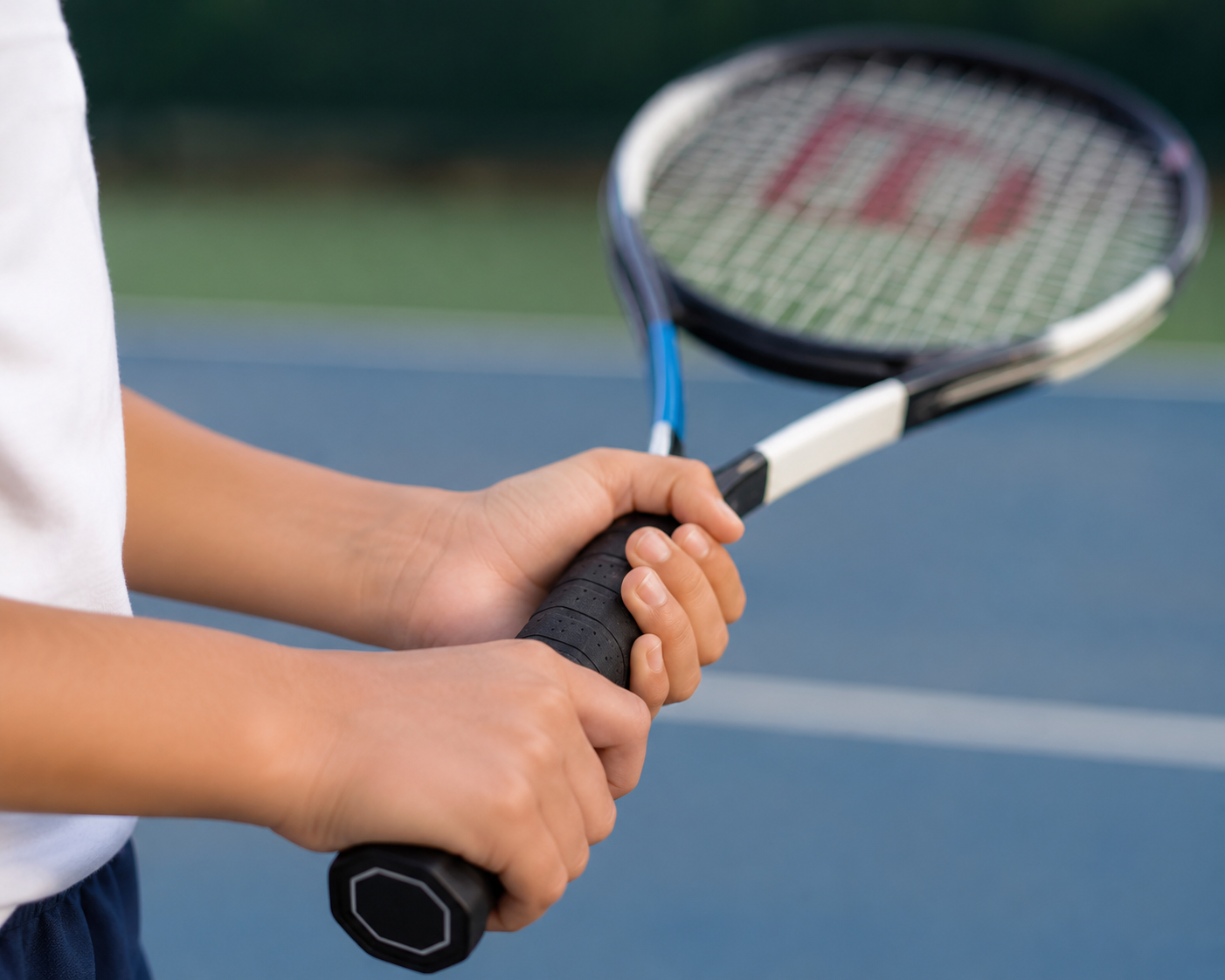
Grip size is the size of the racquet handle. It sounds minor, but it affects comfort, control, and how relaxed your hand feels while playing.
If the grip is too small, you may squeeze too hard to stop the racquet from twisting. If it is too large, it can feel awkward to change grips or relax your wrist.
A simple rule: if you are between sizes, choose the slightly smaller size and add an overgrip.
Common adult grip sizes:
- L1 / 4 ⅛ inches
- L2 / 4 ¼ inches
- L3 / 4 ⅜ inches
- L4 / 4 ½ inches
Many women and smaller-handed players choose L1 or L2. Many men and larger-handed players choose L3 or L4. But hand size varies, so do not treat this as a strict rule. If you can, hold the racquet before buying. It should feel secure, not bulky.
5. Strings: do not overthink them yet
Strings can get very technical, but as a beginner, you do not need to start there.
If the racquet comes pre-strung, that is completely fine for your first lessons. Play with it first. Learn how the racquet feels. Then, once you understand your game better, you can think about string type and tension.
For beginners who are restringing, a basic synthetic gut or multifilament string is usually a comfortable, sensible place to start.
Avoid choosing a harsh, advanced string setup just because you saw a professional use it. Pros hit with much faster swing speeds and often have very different needs from beginners.
6. Do you need to buy a racquet before your first lesson?
Not always. If you are taking a lesson with a coach or club, ask whether they can lend you a racquet for the first session. Many coaches can.
That said, buying your own racquet makes sense if:
- you know you want to continue playing
- you want consistency between lessons
- you are joining a beginner course
- you dislike borrowing shared equipment
- you found a reasonably priced beginner-friendly model
You do not need to spend a fortune before you know whether you enjoy tennis. But if you are already excited to play regularly, a good beginner racquet is a worthwhile first investment.
Beginner racquets worth considering
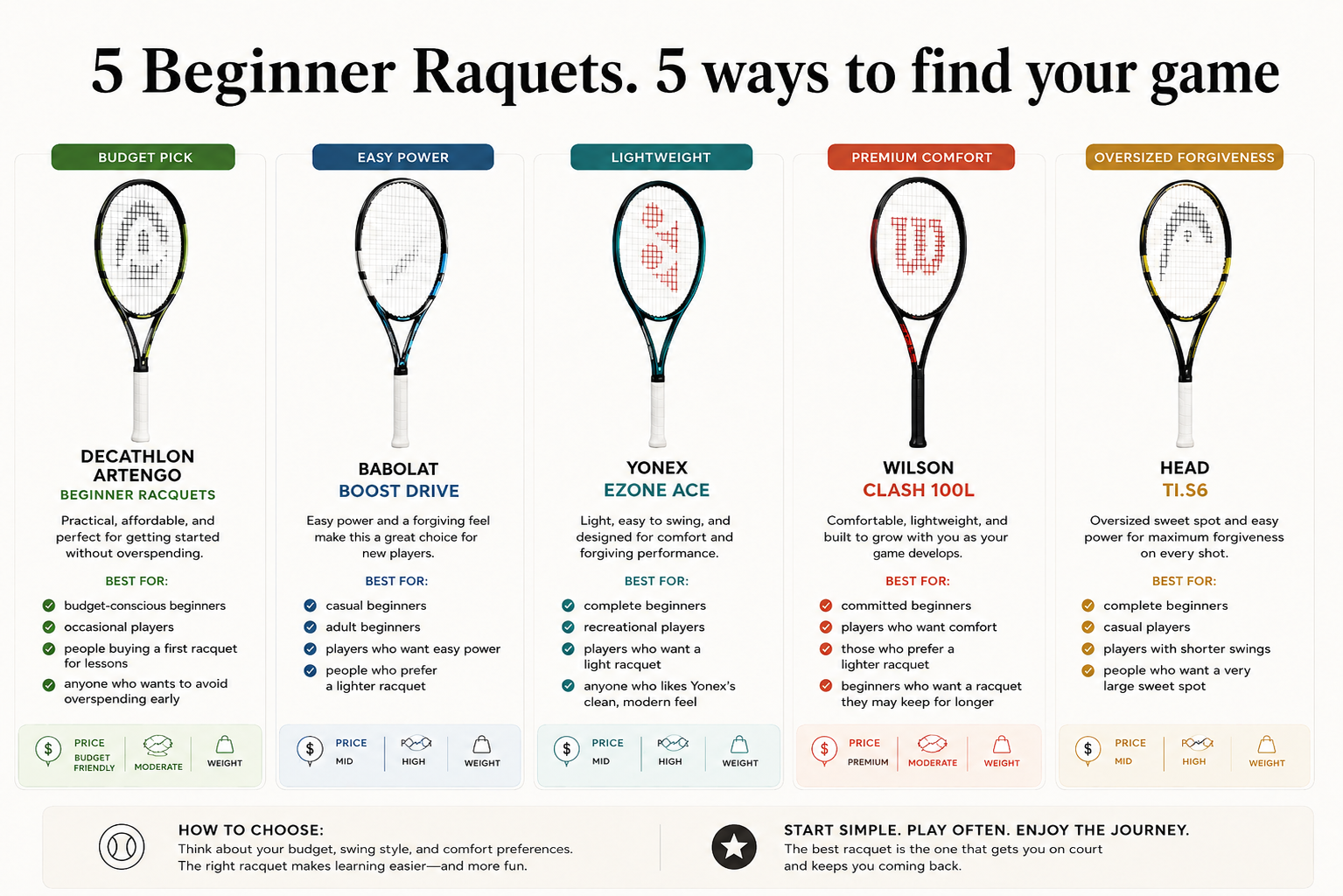
This is not a ranking, and it is not a list of racquets you must buy. Think of it as a starting point: real models that beginners often come across when shopping.
Babolat Boost Drive
Good for beginners who want something lightweight, easy to swing, and not overly complicated.
The Babolat Boost Drive is a popular beginner-friendly option because it offers easy power and a forgiving feel without feeling like a toy racquet. It is a good choice if you want a proper graphite racquet but are not ready to spend premium racquet money.
Best for:
- casual beginners
- adult beginners
- players who want easy power
- people who prefer a lighter racquet
Yonex EZONE ACE
Good for beginners and recreational players who want a reliable, easy-power racquet.
The Yonex EZONE ACE is designed for beginners to recreational players, which makes it a sensible option for someone buying their first proper racquet. It sits in that useful beginner zone: light, approachable, and forgiving enough to make early rallies less frustrating.
Best for:
- complete beginners
- recreational players
- players who want a light racquet
- anyone who likes Yonex's clean, modern feel
Wilson Clash 100L
Good for beginners who want something comfortable, lighter, and more premium.
The Wilson Clash 100L is not the cheapest beginner option, but it can be a strong choice if you want a racquet that feels comfortable and has room to grow with you. It is especially worth considering if you are already committed to lessons and want something more elevated than an entry-level frame.
Best for:
- committed beginners
- players who want comfort
- those who prefer a lighter racquet
- beginners who want a racquet they may keep for longer
HEAD Ti.S6
Good for beginners who want maximum forgiveness and easy power.
The HEAD Ti.S6 is one of those racquets many beginners come across because it is lightweight, oversized, and often widely available. It can be very forgiving, especially for players with shorter swings, but it may feel too powerful for athletic beginners who already generate a lot of swing speed.
Best for:
- complete beginners
- casual players
- players with shorter swings
- people who want a very large sweet spot
Decathlon Artengo beginner racquets
Good for beginners on a budget who want a practical first racquet.
If you are not ready to invest in a bigger tennis brand yet, Decathlon's Artengo range can be a sensible place to start. These racquets are often budget-friendly and easy to access, especially if you are still deciding whether tennis will become a regular hobby.
Best for:
- budget-conscious beginners
- occasional players
- people buying a first racquet for lessons
- anyone who wants to avoid overspending early
How much should you spend on your first tennis racquet?
A good first racquet does not have to be expensive. As a rough guide:
- Under $50: okay for very casual use, but often less durable or less comfortable
- $50–$120: a realistic beginner range for many recreational players
- $120–$200: good if you want a proper racquet with room to grow
- $200+: not necessary for your first racquet unless you are already committed
The sweet spot for most beginners is not the most expensive racquet. It is the racquet you will actually use, learn with, and feel comfortable swinging.
Should you buy used?
Yes, if you know what to check. A used racquet can be a great deal, especially if it is from a reputable brand and has not been damaged. But beginners should be careful because it is easy to buy something too advanced, too heavy, or in poor condition.
Before buying used, check:
- cracks in the frame
- worn bumper guard
- damaged grommets
- grip condition
- whether the strings look very old
- whether the racquet feels comfortable in your hand
A used racquet may also need new strings or a new grip, so factor that into the total cost.
What to avoid when choosing your first racquet
- Buying a racquet just because a professional uses it
- Choosing the smallest head size because it looks more advanced
- Buying something too heavy because it feels serious
- Ignoring grip size
- Spending too much before you know how often you will play
- Choosing a racquet purely based on colour
- Buying a children's or junior racquet by accident
- Overthinking strings before you have played enough to feel the difference
A racquet can help, but it will not replace lessons, footwork, or practice. Choose something sensible, then get on court.
My simple recommendation
If you are a complete beginner, choose a light-to-medium racquet with a forgiving head size and a comfortable grip. If you want the easiest possible shopping rule, use this:
- Casual beginner: choose something light, forgiving, and affordable
- Athletic beginner: choose something around 100–105 sq in with a little more weight
- Nervous beginner: choose a larger, more forgiving head size
- Committed beginner: consider a slightly better frame you can grow into
- Budget beginner: start with a simple Decathlon/Artengo or entry-level graphite racquet
The best first tennis racquet is not the one with the most impressive specs. It is the one that lets you stop worrying about equipment and start enjoying the game.
Final note
Your first racquet does not have to be perfect. It just has to be comfortable enough to help you learn.
Pick something forgiving, avoid anything extreme, and do not spend so much that the decision becomes stressful. Once you have played for a few months, you will understand your own game far better — and your next racquet choice will be much easier.
Before your first lesson, pair this with: