Gear
What to Expect at Your First Tennis Lesson
Chloe · 27 June 2026 · 10 min read
You have booked your first tennis lesson. Now the second guessing starts: what will actually happen? What if you are terrible? What should you wear? What do you bring? And is there anything you should know before you walk onto court?
This guide answers all of it. A first tennis lesson is far less intimidating than it sounds, and knowing what to expect beforehand makes an enormous difference to how much you enjoy it.
Table of Contents
- What Actually Happens in a First Lesson
- The Lesson, Minute by Minute
- What Your Coach Is Actually Doing
- The Thing Nobody Warns You About: Footwork
- Common Worries, Answered Honestly
- What to Bring and Wear
- What Comes After Your First Lesson
What Actually Happens in a First Lesson
Most first lessons follow a similar structure, regardless of whether you are taking a private lesson or joining a beginner group.
You will spend the majority of the time hitting groundstrokes, the shots you make from the back of the court after the ball bounces. The forehand usually comes first because it is the most natural stroke for most people. The backhand, the serve, and the volley. Those come in later sessions.
Your coach will feed balls to you one at a time, in a predictable spot. The pace will be slow. The distance will be short. The goal is not to see how good you are. It is to help you start building muscle memory for the basic swing motion.
By the end of a one hour lesson, most beginners have hit their first forehand, made their first rally, and surprised themselves with how quickly something clicked.
The Lesson, Minute by Minute
A typical one hour beginner lesson breaks down roughly like this. Tap each phase below to see what happens, what your coach is focused on, and what to remember.
This is a rough guide. Every coach structures a lesson slightly differently, and a group session may look different from a private one. But the arc is almost always the same: warm up, learn the forehand, start rallying, finish with a short serve intro, and debrief.
What Your Coach Is Actually Doing
While you are focused on hitting the ball, your coach is watching something completely different. They are looking at your grip, your swing path, your contact point, and how naturally your body moves.
They are not judging you. They are not comparing you to other beginners. They are diagnosing: what one thing, if changed, would make the biggest difference to this player right now? Then they correct that one thing, not everything at once.
This is why good coaches give one instruction at a time. "Watch the ball" comes before "rotate your shoulders," which comes before "follow through high." The progression is deliberate. If you feel like you are only getting one piece of feedback per rally, that is exactly right.
If you are ever confused by a correction, ask. "Can you show me again?" is something coaches hear every lesson. It is not a sign of struggling. It is how people learn.
The Thing Nobody Warns You About: Footwork
Most beginners expect a first lesson to be about swinging a racquet. What surprises almost everyone is how much of it is about their feet.
Tennis requires constant small adjustments: stepping into the ball, splitting to ready position between shots, recovering back to the centre after each stroke. A lesson with a coach feeding balls controls the pace and placement so you can focus on the swing, but the moment you start rallying, footwork becomes the variable that determines whether you are in the right position to hit at all.
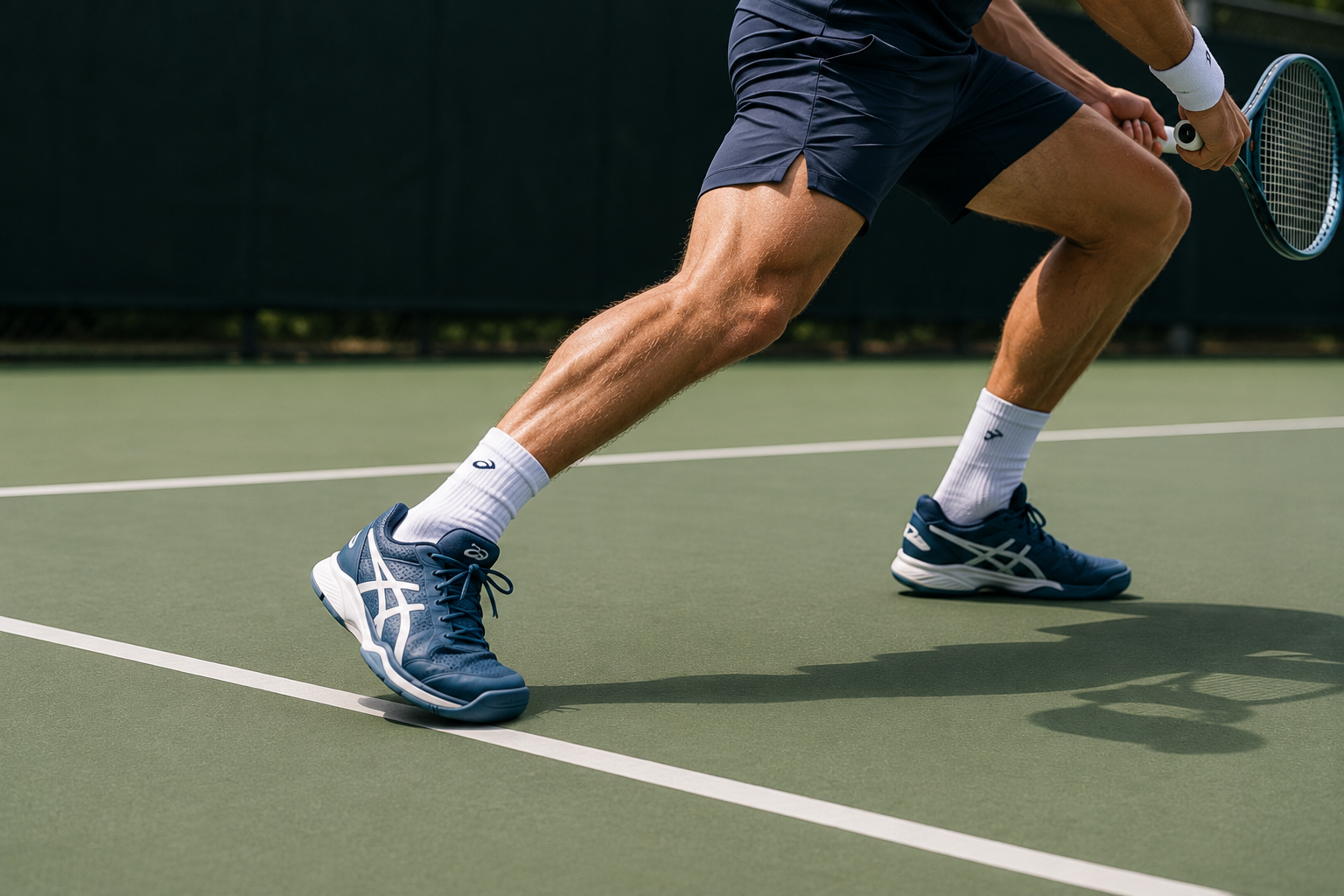
You do not need to master footwork on day one. But noticing it early puts you ahead. After your lesson, try this: without a racquet, stand in the middle of your room and practise the split step, a small hop so both feet land just before an imaginary ball arrives. It sounds trivial but it is one of the most fundamental habits in tennis.
Common Worries, Answered Honestly
Almost every beginner walks into their first lesson carrying at least one of these anxieties. Select the one that sounds most like you.
What to Bring and Wear
For a first lesson, you need very little. Most coaches provide balls and sometimes a loaner racquet if you do not own one yet.
The short version: water bottle, small towel, sunscreen if you are playing outdoors, and comfortable clothes you can move in. Your footwear matters more than your outfit. Flat soled trainers with reasonable grip work fine for lesson one, but court specific shoes become important once you play regularly, built for the lateral movement tennis demands.
For a full breakdown of everything to pack, the first tennis lesson checklist covers every item worth bringing, and a few things worth leaving at home.
On the outfit side: anything fitted enough to move in is fine. If you want guidance on building a proper court wardrobe from scratch, the beginner tennis outfit guide covers tops, bottoms, shoes, and accessories at every budget.
What Comes After Your First Lesson
One lesson builds awareness. Two lessons start to feel like progress. By lesson three or four, most beginners have a reliable forehand, some basic footwork instinct, and a sense of what they are actually working towards.
The single biggest thing you can do between lessons is not hit more balls. It is to review what your coach told you. The corrections given in a first lesson tend to get forgotten within 48 hours unless you write them down. A note on your phone with the two or three things your coach said is worth more than an extra hour of unsupervised hitting.
A few things to think about after your first session:
- What did your coach correct most often?
- Which part of the lesson felt most natural?
- Did the serve feel approachable or still mysterious?
- Do you want to book weekly lessons, or is fortnightly more realistic?
You might also want to start thinking about your own kit. Choosing a first racquet is simpler than it looks once you know what to look for, and having your own gives you the option to practise between lessons.
When you are ready to understand scoring properly, and you will want to eventually, the tennis scoring guide explains points, deuce, tiebreaks, and how to call the score out loud, with interactive diagrams throughout.
For the unwritten side of the sport, including when to walk, when to wait, and what to say at the net, tennis etiquette for beginners covers everything you need to feel confident on any court.
The most important thing you can do after your first lesson is book your second one.